
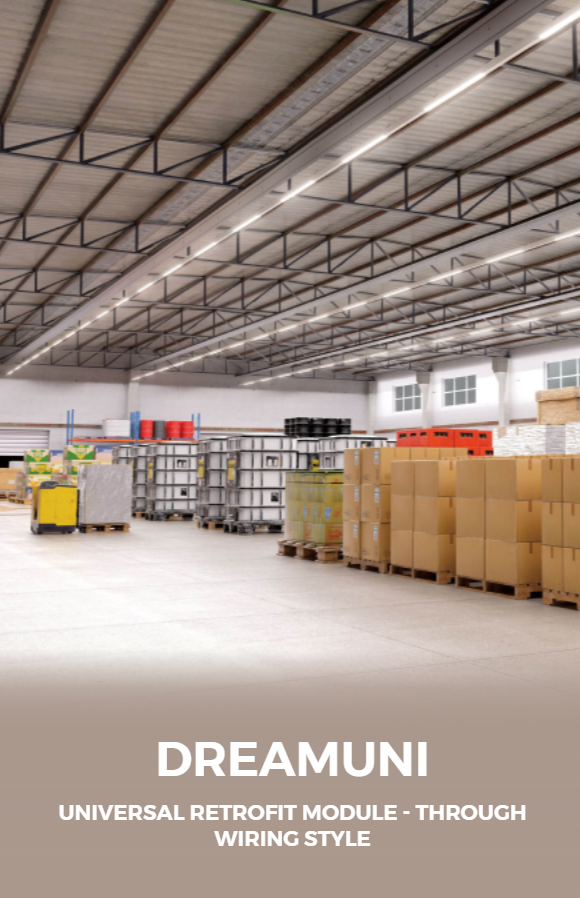
Begin with what people actually do under the lights
Start by listing tasks: picking, scanning barcodes, filling pallets, inspection and forklift movement. Match light levels to tasks rather than to an idealised wattage. If you plan a retrofit, consider whether you can swap the whole fitting or fit a replaceable led module into existing gear; many teams keep operations running by choosing a retrofit luminaire solution during staggered upgrades. From projects I’ve specified over the last decade, including a retrofit at a Zurich distribution centre, the most reliable outcomes come from matching lux to task first, then selecting fixtures that deliver that light efficiently.
Decide target illuminance and uniformity
Warehouses need different lux in different zones. Use these practical targets as a starting point and adjust for your operation:
– General storage: 100–150 lux. – Aisles and picking: 150–300 lux. – Packing, inspection or quality control: 300–500 lux.
Also check uniformity across racking aisles—aim for ratios near 0.4–0.6 (min/avg) so workers don’t move from bright to dark patches when scanning or picking.
Match mounting height to beam distribution
Mounting height changes the required beam pattern. High‑bay at 8–12 metres needs narrow to medium beams (15°–60°) and optics that cut spill. Lower ceilings benefit from wider Type V distributions. Measure the actual ceiling height and rack width; then choose an optic that keeps aisle illuminance even without wasted light on mezzanines or walls.
Choose colour and optics for task clarity
Prefer 4000–5000 K for warehouses. That range balances visual acuity and perceived brightness without looking cold. For inspection areas, specify CRI 80+; for general storage CRI 70–80 is usually acceptable. Opt for lenses or reflectors that reduce glare and prevent reflections on packaged goods and screens.
Prioritise thermal design and component quality
Heat shortens LED life. Check for aluminium heatsinks and tested thermal paths. Look for LM‑80 data on LEDs and TM‑21 projections where available; they indicate lumen maintenance claims you can trust. Choose drivers with defined lifetime ratings, low THD, and surge protection. IP ratings matter near docks or washdown zones—use IP65 where dust or water is present.
Controls: sensor compatibility and dimming strategy
Decide if you want occupancy sensors, daylight harvesting or zone dimming. Confirm fixture compatibility with 0–10 V, DALI, or the protocol your controls vendor uses. Test one control sequence in situ before committing to fleet‑wide upgrades. Simple schedules and motion sensors often deliver the biggest operational savings with the least complexity.
Retrofit versus full replacement — weigh the trade-offs
Options:
– Retrofit modules: faster installation, lower upfront cost, reuses housings and conduit. Good for staged upgrades and where ceilings are in sound condition. – Full replacement fixtures: cleaner thermal design, modern optics and longer warranty; more costly and disruptive.
Choose retrofit when mechanical mounting, ceiling integrity, and electrical capacity are sound. Choose full replacement for aged or damaged fixtures, or when you need a significant optical or thermal improvement.
Common mistakes that lead to rework
– Underspecifying lux for critical tasks. – Ignoring beam pattern vs. rack layout (leads to streaking). – Buying LEDs without LM‑80/TM‑21 or with vague driver specs. – Assuming all dimming systems are compatible. – Skipping surge protection in dockside or outdoor‑facing areas.
Quick checklist for procurement
– Target lux and uniformity for each zone. – Mounting height and chosen beam angles. – CCT and CRI for task needs. – LM‑80/TM‑21 data and driver life rating. – IP rating and mechanical robustness. – Controls protocol compatibility and surge protection. – Warranty terms, serviceability and availability of modules or lenses.
Final synthesis and practical next step
Make decisions that keep people productive: pick fixtures that deliver the right lux, the right distribution and reliable life over time. Avoid vague lumen claims; verify thermal testing and driver specs. When you need solutions that combine replaceable modules, tested optics and pragmatic service options, consider partners who supply modular retrofit choices alongside full fixtures—this is the practical route many logistics teams take, and one reason teams lean toward proven suppliers such as trieco for staged, low‑risk upgrades that preserve workflow while improving light quality.